
Sridhar Vembu, Zoho Corp's chief executive officer (CEO), said on Tuesday a report that he financially abandoned his wife and son is "complete fiction". An article in Forbes magazine alleged Vembu, founder of the Indian SaaS company, had abandoned his wife Pramila Srinivasan and their special needs son in the US in 2020. Srinivasan and Vembu are fighting a divorce case in California.

'We would like to develop Andhra Pradesh into a logistics hub not only for India, but also for South Asia.'

Open order books in February breach 700,000; wait period for some models exceed a year.

'It is Dhoni, Fleming and the support staff who decide on cricket.' 'The fans expect CSK to do well, and with Dhoni at the helm, CSK is capable of it.'

Chief Economic Advisor (CEA) V Anantha Nageswaran on Thursday said describing India's recovery as 'K-shaped' was wrong as both rural and urban economies were recovering, albeit at different paces. Speaking to reporters at the Finance Ministry, Nageswaran said the gross domestic product (GDP) growth print for the recent October-December quarter (Q3FY23) will likely be revised upwards. "The notion of using the letter 'K' to denote urban and rural is somewhat wrong because it is almost as if one is growing and one is contracting. "I would say one segment's slope is more positive, and the other one slope is less positive but it is positive," Nageswaran said.

India is now much ahead of other large railway networks in the world in terms of electrification -- with the US at just 1 per cent, China at 72 per cent and Europe at 60 per cent.

With just a month left in this financial year, electric two-wheeler sales, so far, are at just 62 per cent of the ambitious target of 1 million units set for 2022-23 by the NITI Aayog. According to VAHAN data, compiled by the Society of Manufacturers of Electric Vehicles (SMEV), 620,006 units of electric two-wheelers were sold across the country in FY23 until February 21. Though the industry may miss the 1-million target, sales in FY23 are already up 146 per cent from 249,621 units sold in FY22.

Following a gap of several months, global brands like Walmart have started lifting orders from Tiruppur's garment makers, leading to growth in knitwear exports in January after five months. Knitwear exports from Tiruppur increased 1.5 per cent in dollar terms and 11.6 per cent in rupee terms in January. According to the Tiruppur Exporters' Association (TEA), global majors have started placing more orders from the region.

AzaadiSAT had around 75 small payloads developed by schoolgirls of 75 rural schools.

Five state-run general insurance companies have a total exposure of Rs 347.64 crore, or 0.14 per cent of their total assets under management (AUM), in Adani group of companies, the finance ministry said on Monday. In a written reply to a question by Congress' Manish Tewari, Minister of State for Finance Bhagwat Karad said Life Insurance Corp (LIC) held Rs 35,917.31 crore in debt and equity of Adani group of companies as on December 31, 2022. This is 0.97 per cent of its total assets under management (AUM) of Rs 41.66 trillion.
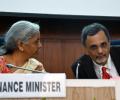
'... and without necessarily calling them Economic Surveys.' 'One should stick to the main focus, which is to give people a good perspective on how the economy is doing.'

'They have started becoming an important player, but not at the same level as they were in the earlier part of the decade.'
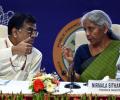
'...Market-linked debentures, high-value insurance, exemptions from capital gains by investment in real estate, etc.' 'So, there are a number of measures directed at collecting a fair share from higher income individuals.'

Local residents say until about two months ago, this board carried the name of Motorola, which once had a manufacturing unit in Sriperumbudur, 40-odd km from Chennai in Tamil Nadu. In May 2020, Luxshare Precision Industry Co, a China-headquartered AirPods and iPhone assembler, had entered into a deal with the Tamil Nadu government to take over the defunct Motorola unit.
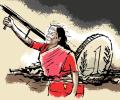
Ahead of the 2023-24 Union Budget, the thinking at the top level of the central government is clear: Gross domestic product (GDP) growth of 6-6.5 per cent is a comfortable enough target for FY24 and the focus should be on fiscal consolidation to ensure that the sovereign cost of borrowing does not become prohibitively expensive in a high-interest rate environment, according to people in the know. Those aware of deliberations between the Prime Minister's Office (PMO) and the Ministry of Finance said while the Budget would look to strike a balance between infrastructure investment and welfare schemes, it is unlikely to be populist, though it will be the last full-year Budget before the 2024 Lok Sabha election. Incidentally, 6-6.5 per cent GDP growth is what the upcoming 2022-23 Economic Survey is expected to project for FY24.

Coming Wednesday, Finance Minister (FM) Nirmala Sitharaman will present the 2023 Union Budget - the last full Budget ahead of the 2024 Lok Sabha elections. While India exited 2022 as a relatively bright spot in the global economy, the FM will endeavour to present a Budget that insulates India's economy against global headwinds and recession in advanced economies, while sticking to the path of fiscal consolidation. In this, she is being helped by her core team of trusted advisors.

Both are finding it difficult to sell one each of their plants -- Chennai Maraimalai Nagar (Ford) and Talegaon near Pune (GM) -- and are finding the road blocked by employee severance snarl-ups, report Sohini Das and Shine Jacob.

'The semiconductor supply is constantly improving, with visible green-shoots in the situation as compared to earlier part of last year'

For fiscal year FY23, the 2022 Union Budget had targeted a capex outlay of Rs 7.5 trillion, which is 35.4 per cent higher than the FY22 Budget Estimate of Rs 5.54 trillion.

'In terms of semiconductors, challenges do remain in the pan industry, but I think we are much better than where we were a year or so back.'
 © 2026 Rediff.com - Investor Information - Advertise with us - Disclaimer - Privacy Policy - Sitemap - Feedback - About us - Terms of use - Grievances